





Ukraine recruits volunteer IT army to hack list of Russian entities
The list is composed of 31 targets including Russian critical infrastructure, government agencies, banks, and hosting providers. Ukraine’s Minister for Digital Transformation Mykhaylo Fedorov called for this action to fight against Russia on the cyber front. A Telegram channel was used to coordinate the efforts and plan the cyber-attacks that will be conducted by the IT Army. It includes a message that reads, “For all IT specialists from other countries, we encourage you to use any vectors of cyber and DDoS attacks on these resources.” The targets include Gazprom, Lukoil, and a number of mineral and industrial domains, as well as branches of the Russian government.
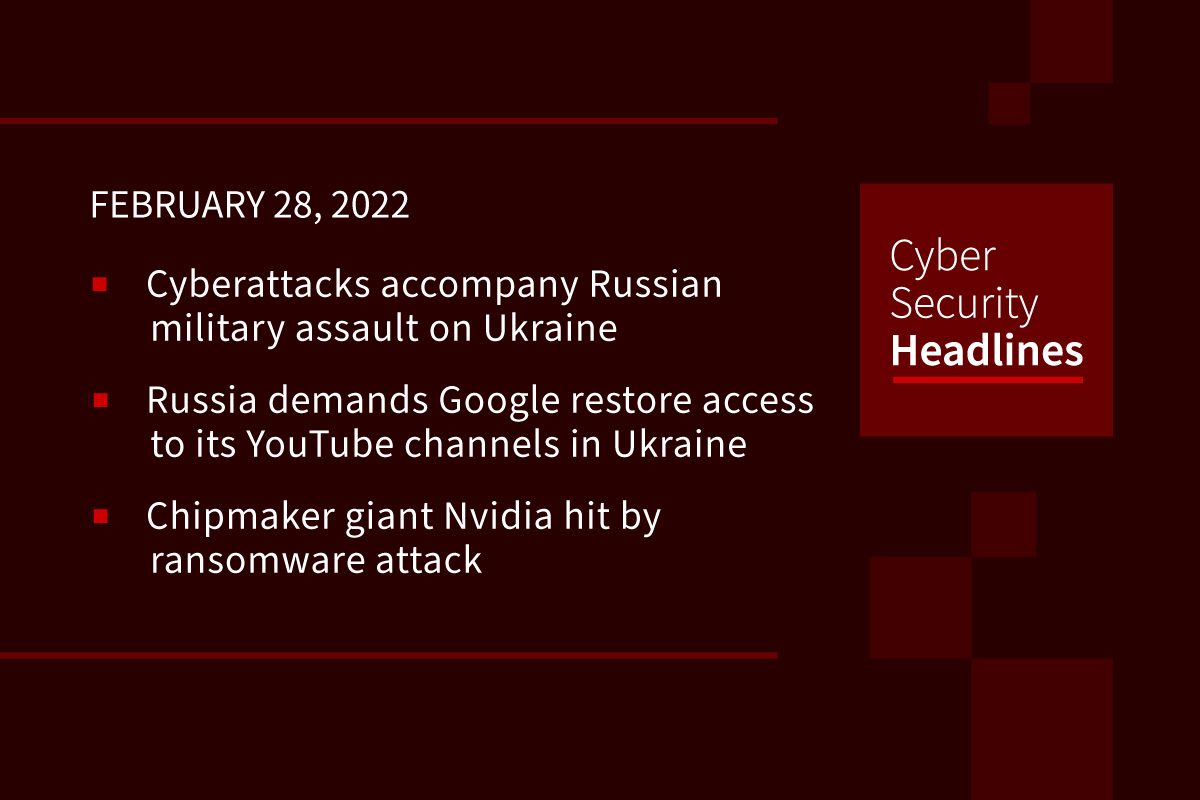
Russia demands Google restore access to its media YouTube channels in Ukraine
Russia’s state communications regulator on Sunday said it had written to Google and demanded that access to Russian media’s YouTube channels be restored on Ukrainian territory. The regulator, Roskomnadzor, said it wanted all restrictions imposed on the Russian-language YouTube channels of media outlets RBC, TV Zvezda and Sputnik to be removed. Moscow on Friday said it was partially limiting access to Meta Platforms, accusing it of “censoring” Russian media. Moscow has also increased pressure on domestic media, threatening to block reports that contain what it describes as “false information” regarding its military operation in Ukraine.
(Reuters)
Chipmaker giant Nvidia hit by ransomware attack
The impacted some of its systems for ten days. The security breach is not connected to the ongoing crisis in Ukraine, according to a person familiar with the incident. The incident also impacted the company’s developer tools and email systems, but business and commercial activities were not affected. Bleeping Computer reported that an insider described the security breach as having “completely compromised them.” The Lapsus$ ransomware gang is claiming responsibility for this attack, the group announced to have stolen one TB of data from Nvidia’s network.
Android app lets users detect Apple AirTag tracking
A team of researchers at Darmstadt University in Germany have published a report illustrating how their AirGuard app for Android provides better protection from stealthy AirTag stalking than other apps. Apple’s own Android app Tracker Detect, pales in comparison to its iOS counterpart, and will only inform the victim they are tracked if it’s commanded to perform a manual scan. The university researchers reverse-engineered the iOS tracking detection app and then designed the AirGuard app, a fully automatic and passive detection anti-tracking solution that works against all Find My accessories and other tracking devices. It is an open source software and is currently available for free on the Google Play Store.
There are many misconceptions about security automation, so Torq is debunking a security automation myth each day this week.

Incorrect. Proactive management of security incidents is just as important, like automatically scanning IaC configurations to detect vulnerabilities, automating collaboration between devs, IT ops and SecOps to prevent risks before they’re threats. To learn more about the realities of automation, head to torq.io.
Conti gang faces off against Anonymous in cyber war
The group behind the Conti ransomware has publicly announced its full support for the Russian government, and has threatened to strike the critical infrastructure of anyone launching cyberattacks or war actions against Russia. The move comes after Twitter accounts claiming association with the Anonymous hacktivist collective declared “cyberwar” against the Russian government. Anonymous has already claimed responsibility for taking down Russian government websites, including the Kremlin and State Duma. In a later message, the group revealed it had targeted the website of the Russian-state controlled international television network RT. Analysts warn that the involvement of hacktivists and cybercrime groups in the conflict, supporting one side or another, could spiral into a wave of escalating attacks and provide cover for destructive cyber actions directed by government agencies.
(CSOOnline and InfoSecurity Magazine)
Fujitsu confirms end date for mainframe and Unix systems
Fujitsu has confirmed the end of the road for its mainframes and Unix server systems. It will cease to sell both by the end of this decade. Customers are by then expected to have migrated to the cloud. The tech giant’s plans were revealed in a notice posted to the Japanese IT giant’s website on February 14th, but was not widely publicized. Support services for both portfolios will continue for five years afterwards, meaning these will end in 2034 for Unix servers and 2035 for mainframes.
Millions in Bitcoin pouring into Ukraine from donors
Researchers at Elliptic, a blockchain analysis company, say the Ukrainian government, NGOs and volunteer groups have raised the money by advertising their Bitcoin wallet addresses online. More than 4,000 donations have been made so far, with one unknown donor gifting Bitcoin worth $3m to an NGO. On Saturday afternoon, the official Twitter account of the Ukraine government posted a message: “Stand with the people of Ukraine. Now accepting cryptocurrency donations. Bitcoin, Ethereum and USDT.” It posted addresses for two cryptocurrency wallets which collected $5.4m in Bitcoin, Ether and other coins within eight hours.
(BBC News)
Beware: new IRS rules will lead to a wave of phishing frauds
New legislation that went into place at the beginning of this year threatens millions of small businesses with the potential for a fresh scam. Beginning in the 2022 tax year, small businesses that receive more than $600 in total payments during the course of the year from a payment service like PayPal, Venmo, Square, Stripe, or online sales through Amazon, Etsy and other marketplaces, will require that there amounts are reported to the IRS via Form 1099-K in early 2023. With providers like PayPal now needing additional information from users, such as social security and tax identification numbers, security specialists warn that phishing scams asking for the same information and disguised as legitimate sources such as PayPal or the IRS will have a field day.